Sitemap
.jpg)
As part of the brainstorming and leading wireframe decisions, we made a sitemap of the screens and the controls the user will get on each screen. This will make it better and easier to work on the hi-fi prototypes in the next milestone.
Feature List
The group connected over a zoom call to decide on the features the LingoTalk application will possibly have and the possible screens that need to be made to give the user those features.

LingoTalk
Coming together to break the language barrier!

Project overview
About
Have you tried to learn a new language through a course or ‘language learning’ app and wound up forgetting about your goal or losing motivation? You may have even tried to find a partner to hold you accountable and keep you motivated, but finding someone can be a struggle. Or, if you did succeed in learning the language (congratulations!), you might have learned the grammar and formal version of the language. However, holding a conversation with someone is probably still challenging due to unfamiliarity with everyday language or different dialects.
Relevance
Learning a new language isn’t just about memorizing grammar or passing quizzes it’s about actually using it in real life. Most language tools focus on the basics but don’t prepare you for real conversations, local slang, or the way people actually speak. That gap can leave learners feeling stuck or discouraged. This project bridges that gap by focusing on natural communication, helping learners build real-world fluency, not just textbook knowledge.
Problem
Traditional language learning tools often feel disconnected from how people actually speak. Learners might make progress in apps or classes, but when it comes to real conversations, they freeze up. The lack of exposure to informal language, cultural context, and human interaction leaves a gap between knowing the language and using it confidently.
Project goal
Language learners often struggle with staying motivated, especially when learning feels like a solo task. Traditional apps and courses focus heavily on grammar and structured lessons but rarely help learners feel confident in real conversations. This gap between knowing the language and using it naturally can lead to frustration and loss of interest.
Our project focuses on solving this by connecting learners with others who are also trying to improve their language skills. By creating a space where users can chat, share experiences, and grow together, we turn learning into a social, supportive activity. Conversations become a way to learn, not just a goal to reach making the experience more engaging and human.
To support even total beginners, the app includes real-time message translation, so users can jump into conversations from day one. This removes the pressure of needing to “know everything” before speaking and instead encourages natural learning through interaction. It’s a fun, practical way to build fluency, confidence, and connection all at the same time.
Solution
Our solution is to connect with people who are also trying to learn a new language or practice their skills. Finding a community of people you enjoy speaking with will provide you with ample opportunity to practice and keep your motivation alive. This app will allow you to translate your messages in real-time while chatting if you need assistance. Thus, it can especially benefit amateurs who want to learn a new language without prior knowledge since they can immediately start having fun conversing and creating connections with others while building their vocabulary.
Empathize
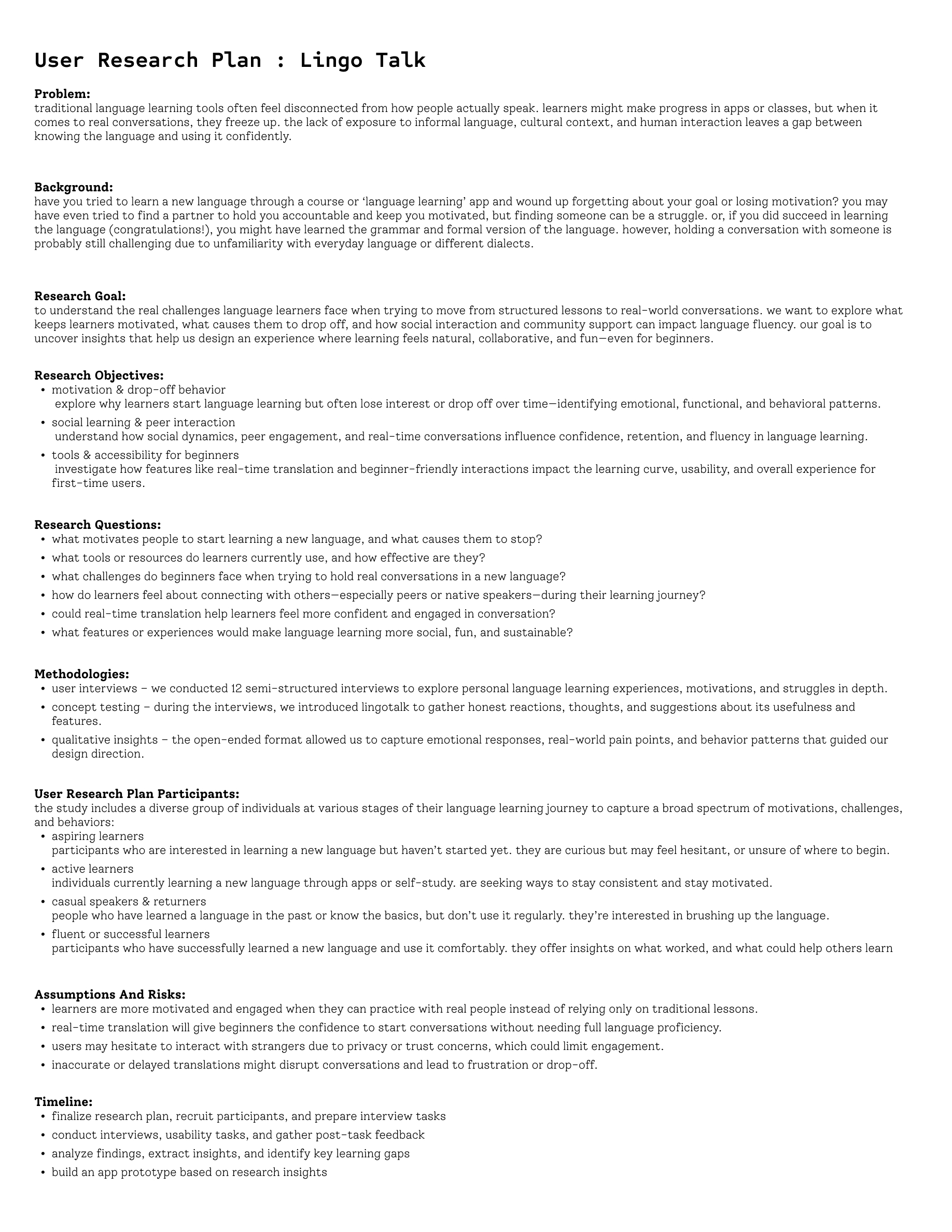
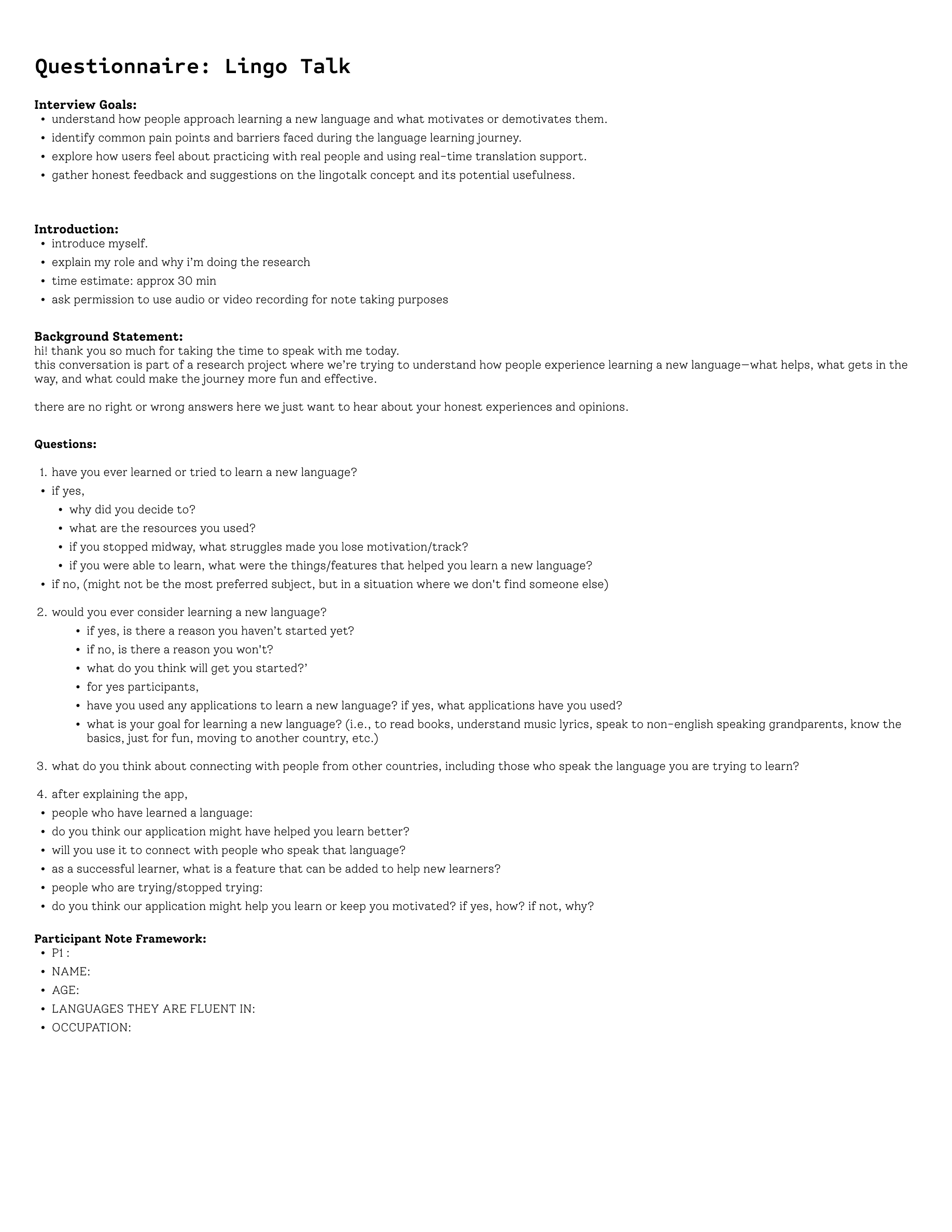
Research Plan + Interview Script
The interview process starts with creating a research plan. This outlines 7 key components:
-
Project background/problem
-
Research goals
-
Research Objectives
-
Research Questions
-
Methodologies
-
Hypothesis
-
Timeline
Research Objectives
Motivation & Drop-off Behavior
Explore why learners start language learning but often lose interest or drop off over time identifying emotional, functional, and behavioral patterns.
Social Learning & Peer Interaction
Understand how social dynamics, peer engagement, and real-time conversations influence confidence, retention, and fluency in language learning.
Tools & Accessibility for Beginners
Investigate how features like real-time translation and beginner-friendly interactions impact the learning curve, usability, and overall experience for first-time users.
Stakeholders
Involving and Communicating with Stakeholders
-
Our stakeholders will initially be involved through interviews, and progress will be communicated through emails.
-
We will use our interviews to avoid miscommunication by providing definitions for ambiguous terms and asking clarifying questions to ensure that all parties are on the same page.
-
We will also give interviewees ample opportunity to ask clarifying questions if they need to do so.
-
Lastly, we will be communicating the design of LingoTalk to our stakeholders through usability testing.


Members of Our Stakeholders Include:
-
People wanting to learn and practice a new language
-
People who want to practice a language they know but don't use daily
-
Travel enthusiasts
-
Individuals who want to connect with people from around the world
Demographics and Tools
Our project aims to make language learning easier by creating a digital community. As a result, our user demographic leans toward a younger audience. However, our interview demographic involved anyone who has ever wanted, tried, or succeeded in learning a different language. All the participants, aged 21 to 35, were from various academic or professional backgrounds, including students to full-time employees. The interviews were conducted via zoom calls and phone calls; some were in-person. The interview audios were transcribed over Zoom and Otter.ai but edited individually. The insights helped us find different perspectives and information that will drive our consecutive steps of this project.
Affinity Diagram
We used the Affinity diagram for organizing our notes from the interviews to understand the user's experiences, frustrations, and needs better. We used Zoom to discuss the notes and diagram and Figma to work on the diagram collaboratively. The following process was followed:
-
The yellow notes were highlights and notes from individual interviews and transcripts.
-
The yellow notes were sorted into groups based on common themes and labeled with blue post-its for the middle-level grouping.
-
Once we had similar themes, it was easier to break them into smaller groups to identify specific and common information, which we clustered under purple post-it notes.
-
Lastly, we arranged the blue post-its under top-level labels, which are the green post-its, that identified the user's experiences, frustrations, and expectations.
The result of the process was the diagram below, which can be accessed here: FIG JAM BOARD
Personas
To create our personas, we researched and considered the contextual inquiry's highest level of points. One primary, two secondary, and one anti-persona were among the four that we developed.
Primary Persona
Secondary Persona(s)

Anti Persona


Secondary Persona(s)
Analyzing Results
From the interviews and interpretation sessions, we gained new insights that we can apply to the design of our app. Our conclusion with the problems and motivations people have while learning a new language are:
-
People mostly want to learn a new language to interact with more people or to enjoy entertainment from different cultures.
-
Peer interaction and cultural exchange make the learning process engaging and motivating for learners.
-
Consistent practice and using the language in the real world instead of only reading and watching led to better understanding and fast learning.
-
People lose motivation either when they cannot find consistent learning methods or cannot find time in their schedule to dedicate to their learning.
-
People are concerned about time zone differences, and some feel embarrassed to talk to people. This finding also made us realize the limitations of our idea.
Our stakeholders are looking for a convenient way to:
-
learn a new language
-
practice newfound knowledge
-
maintain skills
initial Ideas
-
Create an algorithm that pairs individuals based on their needs, interests, and personalities
-
Users first set up their profile by inputting time availability, level, etc., to be paired with others with similar selections
-
Give users the ability to create forums to discuss topics of interest
-
Allow users to give feedback to improve the application (customer service desk)
Prototype
Initial Paper Prototype
Final Paper Prototype


Lo-Fi Prototype
Before moving into the low-fidelity prototype, we began by creating individual wireframes based on user personas, their pain points, and overall experience goals. These wireframes were then brought together in a team discussion, where we reviewed, refined, and aligned on a unified user flow. Through this collaborative process, we combined the best elements from each version to develop a final, cohesive wireframe. This formed the foundation for our low-fidelity prototype, ensuring it was structured, purposeful, and user-centered.


Brand identity
Once the wireframing phase was complete, we transitioned to high-fidelity prototyping by focusing on the application's color palette and typography. This iterative process marked by experimentation and collaborative feedback resulted in the development of a cohesive style guide that defines the visual identity of the LingoTalk mobile app.
High Fidelity Prototype
Returning our focus to the interactions and navigation, we started enhancing buttons, adding additional frames, and including animations to the prototype. The focus of LingoTalk is connecting and chatting with others. As a result, the functionality of the chat and explore features have more depth in comparison to other features. We've excluded frames such as password recovery since the design would follow standard conventions.
Additional settings were added to make it easier for users to choose the languages they wish to see while chatting with others. The questions asked during profile setup will allow the app to make appropriate suggestions and populate the explore tab initially. This helps to mitigate concerns, such as differences in time zone, that were discovered during the contextual inquiry.

User Testing
Usability Testing Summary
Each team member conducted a usability test with two participant, totaling feedback from eight users. The goal was to observe how easily users could navigate and interact with key features of the app.
Tasks Given to Participants:
-
Log in and complete the setup process
-
View the Home page
-
Create a post from the Home page
-
Create a new group from the Home page
-
Explore the Explore page
-
Open the Chat page
-
Check the latest message (expected from Aidan Lee)
-
Find the option to listen to a message
-
View different chat displays for translation
These tasks helped us evaluate the app’s overall usability, clarity of features, and user comfort with its core functions.
Highlights
Pain Points
-
Users found the profile setup process smooth and easy to follow.
-
Navigated quickly to the home page, group icon, explore page, and most recent message.
-
Liked having the option to choose how the chat display looks.
-
Easily figured out how to play audio messages.
-
Some icons (like “create post” and “chat”) were too small or hard to spot.
-
Inconsistent icon design across different sections (e.g., home vs. group pages).
-
Users raised concerns about privacy while chatting.
-
Many didn’t realize they could scroll down to see more suggestions.
-
Took time to locate translation settings within the app.
-
Confusion around the language the app is entirely displayed in.
-
Questions about the reliability of translations—users asked if there would be human moderators or translators.
-
Chat settings titles were unclear and caused confusion.
Final Thoughts
The development of LingoTalk allowed me to engage deeply with the end-to-end design process, from user research and ideation to prototyping and usability testing. This project reinforced the importance of user-centered design and collaborative decision-making within a team setting—skills that are essential in both professional and academic environments. While the initial usability testing involved a limited sample size, it provided meaningful insights that informed our next design iteration. The experience also highlighted areas for improvement in research methodology, particularly the importance of context-driven inquiry.